Washington lawmakers are moving on multiple fronts to curb the most politically toxic corners of prediction markets after millions of dollars flowed into bets tied to US-linked military action in Iran.

Over the past week, several Democratic lawmakers have been pursuing multiple paths to rein in the fast-rising business.
One effort, led by Rep. Mike Levin and Sen. Chris Murphy, focuses on war-related contracts that critics say should never have been listed.
Another, spearheaded by US Senators Jeff Merkley and Amy Klobuchar, would seek to bar elected officials and senior executive branch officials from trading event contracts altogether.
The central tensions in these efforts show that the mounting wagers tied to military action, leadership killings, and other national security events have created intolerable incentives and invite the abuse of nonpublic information.
So, US lawmakers are making a significant effort to nip these activities in the bud and prevent widespread profiteering from these events.
Still, the Commodity Futures Trading Commission (CFTC) is preparing a broader rulemaking that could preserve a legal path for many prediction markets rather than shut the sector down outright.
How Iran war bets became the trigger
The immediate spark was a surge in trading around the US-Israel joint military action against Iran last weekend.
Reuters reported that $529 million was wagered on contracts tied to the timing of attacks and another $150 million on contracts linked to whether Iran’s Supreme Leader Ayatollah Ali Khamenei would be removed from power.
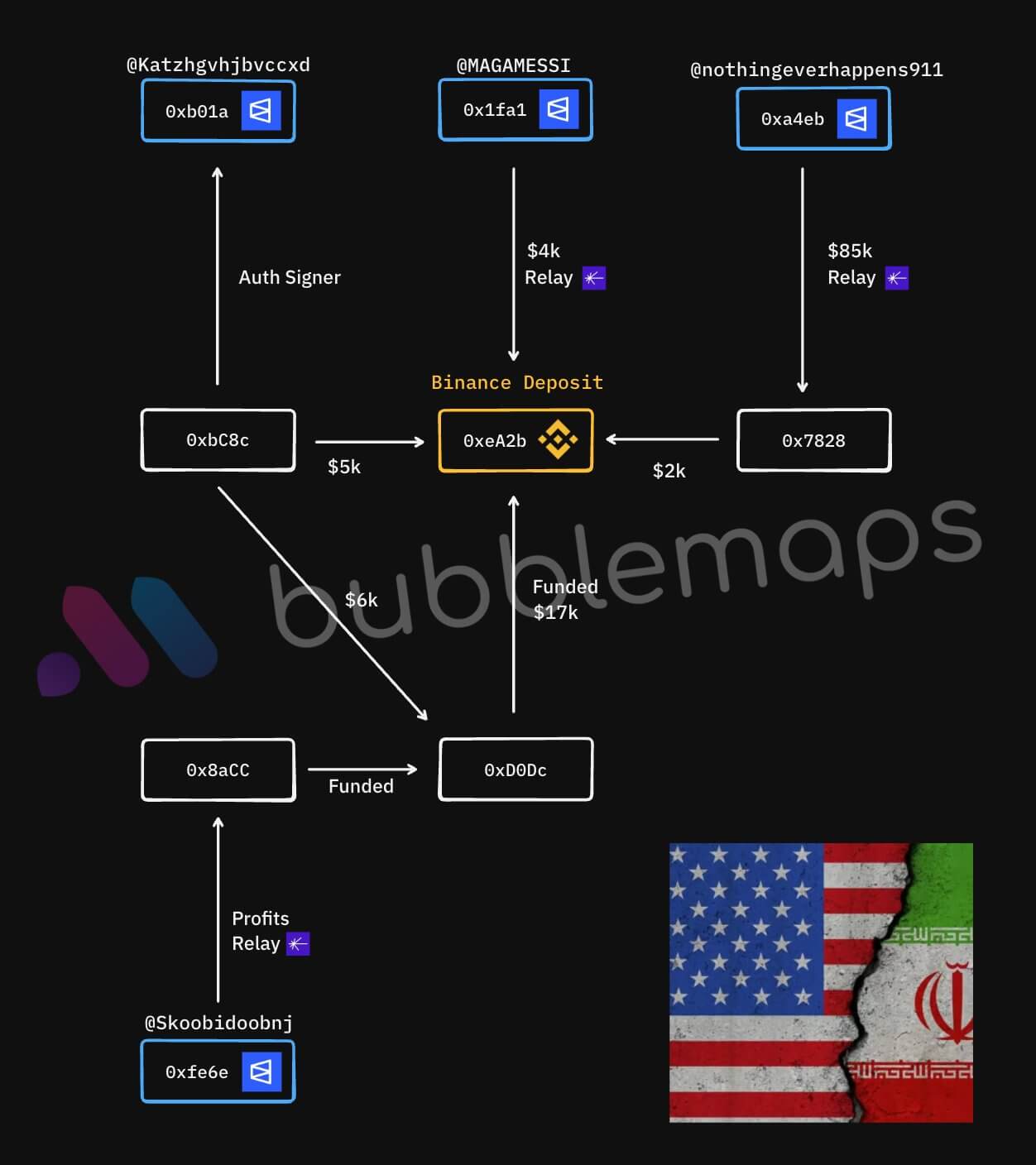
At the same time, crypto analytics firm Bubblemaps pointed out that about 10 accounts made about $1.4 million in profit on Polymarket bets funded in the hours before the strikes.
Those figures gave lawmakers a vivid example of the risk they have been warning about for months.
On the social media platform X, Murphy revealed that he was working on legislation to ban these platforms after the trades raised questions about whether anyone with advance knowledge of military action had profited from it.
He argued that such trades should not be legal and added:
“A handful of people made big, unusual $100,000+ bets on Polymarket – that the U.S. would strike Iran the next day. The Iran War is fueling a new kind of corruption: White House officials secretly profiting off war. It’s disgusting. We need to ban it.”
That line of attack reflects how quickly the issue has moved beyond a narrow dispute about platform rules.
In Washington, the argument is now about whether event contracts tied to war, terrorism, assassination, or other violent outcomes are a moral hazard, a national security vulnerability, or both.
Onshore and offshore markets diverge
The political backlash has also highlighted the divide between regulated US venues and offshore crypto-based platforms.
Kalshi, which operates as a CFTC-regulated exchange, has said it bans insider trading and does not list markets directly tied to death.
On X, Tarek Mansour, the platform’s Chief Executive, said the company did not profit from the Khamenei market after refunding fees to users.
Nonetheless, the episode still exposed how messy these products can become when real-world events outrun the assumptions traders bring to the market.
Polymarket sits in a different position. The platform is currently mostly operating overseas, and it has defended its model by saying that prediction markets harness the wisdom of crowds to create accurate, unbiased forecasts. The platform is making substantial efforts to reenter the US market.
However, it is the same platform that has become the symbol of the current backlash because so much of the controversial volume, including the Iran-related trading and the market on a global nuclear explosion, was concentrated there.
That split matters because it points to the likely shape of any crackdown.
Washington has the clearest leverage over regulated US exchanges such as Kalshi. Offshore venues that rely on crypto rails are harder to police directly.
So, that raises the prospect of a two-tier market in which the most controversial contracts are pushed abroad while domestic platforms stay inside a narrower regulatory perimeter.
Notably, CFTC Chairman Michael Selig acknowledged that risk this week when he warned that blocking these markets outright could simply drive them offshore, “just like crypto.”
US legislative efforts on prediction markets
In light of the above, the policy response now taking shape in Washington is best understood as three overlapping tracks.
The first is a targeted push against war-linked and death-adjacent contracts. Levin and Murphy are working on legislation meant to ban restrictions on contracts that they say exploit military action or reward access to sensitive information.
Levin believes the Commodity Exchange Act, which already bars event contracts considered contrary to the public interest, still leaves too much room for such wagers to exist.
The second is an ethics bill aimed at public officials. Here, Merkley and Klobuchar wants to ban the president, vice president, members of Congress, and other public officials from trading event contracts.
Merkley framed the issue not as a fight over market innovation but as a question of public trust, saying:
“When public officials use non-public information to win a bet, you have the perfect recipe to undermine the public’s belief that government officials are working for the public good, not for their own personal profits. “Perfectly timed bets on prediction markets have the unmistakable stench of corruption.”
The third track runs through the CFTC itself. On Feb. 4, the agency withdrew the prior administration’s proposed event-contract rule and said it would pursue a new rulemaking instead.
Then, this week, Reuters reported that the CFTC sent an advance notice of proposed rulemaking to the White House budget office, the first formal step in building a new framework.
Selig has made clear that he does not want the United States to respond by trying to eliminate the sector. He wants the government to define the rules and preserve federal control over lawful contracts.
Meanwhile, that regulatory approach is colliding with state-level resistance.
On Feb. 17, the CFTC filed an amicus brief in a Ninth Circuit case to reaffirm its exclusive jurisdiction over commodity derivatives markets, including prediction markets.
Selig said CFTC-registered exchanges had faced an “onslaught of lawsuits” designed to undermine the agency’s sole regulatory authority.
In other words, Washington is not only debating what contracts should be legal. It is also fighting over who gets to decide.
Wall Street raises the stakes
The timing of these moves comes at an awkward moment for policymakers, as prediction markets are no longer a fringe experiment.
Data from the crypto research firm Predictefy showed that weekly transactions on these platforms reached nearly 45 million, with notional volume exceeding $6 billion.
At the same time, traditional financial institutions like Intercontinental Exchange, the parent of the New York Stock Exchange, said in October that it would invest up to $2 billion in Polymarket.
That institutional interest complicates the politics. For industry backers, it is evidence that prediction markets are becoming part of mainstream market structure and should be regulated like other derivatives.
For critics, it means a business once dismissed as a novelty is now attracting serious capital even as the most inflammatory contracts center on war, assassination, and government action.
Considering this, the likely outcome of Washington’s latest regulatory onslaught is not a blanket ban on prediction markets.
Congress is divided, the CFTC is moving toward rulemaking rather than prohibition, and platforms still argue that event contracts can serve legitimate forecasting and hedging functions.
However, the Iran wagers appear to have changed the conversation in one important way. They gave opponents a vivid example of how prediction markets can collide with national security, official ethics, and public outrage all at once.
That makes the next battle less about whether prediction markets should exist and more about which ones Washington is willing to tolerate.
If lawmakers succeed, contracts tied to war, death, and sensitive government action may become the first casualties. If regulators move faster than Congress, the US may end up with a narrower, more formalized onshore market while offshore venues continue to test how far crypto-based betting can go.
Either way, the era when prediction markets could present themselves as a niche experiment on the edge of finance is ending.
The post $679M bet on Iran war sparks Washington crackdown on crypto prediction markets appeared first on CryptoSlate.