A recent American Bankers Association (ABA) ad running across Washington shows a clear edge in a campaign that has been running for months.

The ad reads:
“Protect local lending while embracing innovation. Tell Senators to close the stablecoin loophole.”
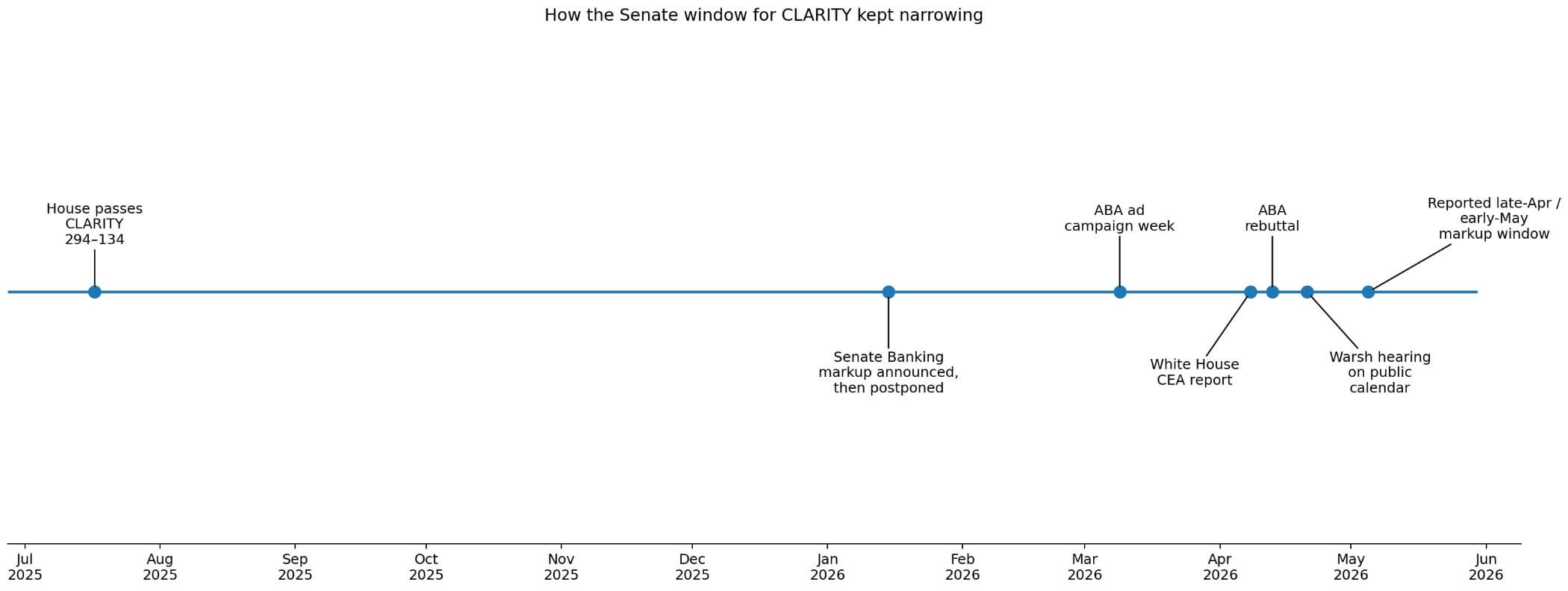
ABA’s advertising archive documents Politico Morning Money placements during the week of Mar. 9, urging senators to act on stablecoin yield, as well as a separate digital campaign targeting Congress, the White House, and regulatory agencies.
In January, more than 3,200 bankers signed a letter calling on the Senate to close what they called the “payment of interest loophole.”
ABA-backed trade groups followed with a joint letter asking Congress to codify a comprehensive ban on stablecoin inducements paid by issuers, affiliated platforms, or third-party partners.
ABA’s Community Bankers Council added that $6.6 trillion in deposits could migrate if the language stays loose. Those are advocacy figures documenting how coordinated and sustained the campaign has been.
All of it is now landing on a Senate calendar that has very little room.
The House passed the CLARITY Act on July 17, 2025, by a margin of 294 to 134, wide enough to give the Senate a clear mandate to act. Senate Banking Chair Tim Scott announced a committee markup for Jan. 15, 2026.
The committee still lists that session as postponed on its official markup page, with no replacement date. The committee’s current public schedule features a Kevin Warsh nomination hearing on Apr. 21, with no CLARITY markup listed.
Reports point to a possible markup in the final week of April or the second week of May, and that floor time before the summer campaign season is limited, and that the bill still carries unresolved disputes over ethics and illicit-finance provisions beyond the banking fight.
Each additional round of negotiation over stablecoin yields further narrows the window. Keeping the yield fight alive long enough to compress the timeline is itself a win for the bank lobby.
What the fight is actually about
The GENIUS Act already prohibits stablecoin issuers from paying interest or yield directly. The bank lobby is targeting the current draft language for containing no explicit prohibition on affiliated platforms or third-party partners paying rewards in tokens.
A crypto exchange holding a yield-bearing stablecoin could, under that architecture, effectively compete for deposits. Banks want that channel closed. That is the substance behind the word “loophole.”
The White House’s Council of Economic Advisers (CEA) found that prohibiting yields on stablecoins would increase bank lending by just $2.1 billion, or 0.02% of the current base, at a net welfare cost of $800 million.
Large banks would capture 76% of the added lending, with 24% going to community banks, the constituency at the center of the local-lending argument.
ABA said five days later that CEA had studied the wrong question, arguing that the real exposure is a future scenario where yield-bearing stablecoins scale large enough to compete directly with deposits, pulling funding out of the banking system before regulators can respond.
The two sides are arguing from different assumptions about the size of the stablecoin market, and senators now have to resolve this dispute.
| Actor | Main claim | Key number / evidence | What they want |
|---|---|---|---|
| ABA / banking groups | Loose yield language could let stablecoins compete with deposits through affiliates and partners | 3,200+ bankers signed January letter; advocacy estimate of $6.6T in potential deposit migration | Close issuer, affiliate, and third-party reward channels |
| White House CEA | A yield ban has only a modest near-term effect on bank lending | $2.1B added lending, 0.02% of base, $800M welfare cost; 76% of added lending goes to large banks | Avoid overstating current lending benefit of a ban |
| BIS / Pablo Hernández de Cos | Deposit shifts could be smaller if stablecoins stay unremunerated and interest bans are enforceable | Supports the importance of remuneration rules under larger-scale scenarios | Preserve enforceable non-yield design if stablecoins scale |
| Senate negotiators | Need language that addresses the “loophole” without derailing CLARITY | Public calendar shows no markup yet; timing pressure is rising | Reach a compromise fast enough to preserve momentum |
BIS chief Pablo Hernandez de Cos said on Apr. 18 that deposit shifts may be smaller if stablecoins stay unremunerated and interest bans can be enforced, a direct validation of the scale-dependent logic ABA has been running.
The White House analysis and the BIS warning are compatible in acknowledging that, in worst-case scale assumptions, a yield ban could eventually produce $531 billion in extra aggregate lending.
Washington is writing rules now for a market that may be substantially larger later.
The coordinated campaign
The public-private combination on the bank side makes this moment different from earlier rounds of crypto lobbying. The ads create visible congressional heat while the bankers’ letters give members a constituent-volume argument.
The CEO-level appeals establish executive accountability, and ABA’s active rebuttal of the White House report confirms the lobby is contesting the economics directly, on quantitative terms.
That combination puts CLARITY’s Senate timeline at a specific kind of risk. The bill carries White House backing, a strong House vote, and broad industry support.
Resolving the committee scheduling problem requires an agreement on yield language before the calendar forces a recess or conflicts with Warsh’s confirmation proceedings. Without that, the postponed January markup becomes a pattern.
The two paths ahead
The constructive path runs through a yield compromise that closes the affiliate and third-party channels clearly enough to satisfy at least the community-bank argument, while preserving enough flexibility to keep stablecoin-adjacent products viable.
The White House report gives negotiators a quantitative basis for holding the line, as the near-term US lending benefit of a comprehensive ban is documented and modest.
Senators Thom Tillis and Angela Alsobrooks have been among the most visible members engaged on the stablecoin language. If either emerges with a narrow compromise that addresses the affiliate channel dispute, a markup could move quickly enough to preserve whatever momentum the House vote still carries.
Language should close the affiliate channel clearly enough to remove ABA’s loophole argument and be flexible enough to keep Circle, Coinbase, and their allies at the table.
Extending that logic to affiliates and platforms faces an obstacle of political will.
The harder path is already visible in the Senate’s public calendar. If banks conclude that maintaining the current position yields better long-run terms than accepting a partial win, the yield fight will stay alive through May.
The ethics and illicit-finance disagreements mean CLARITY arrives at markup carrying more than one open question. Multiple unresolved provisions in a compressed calendar lead to a coalition-management failure, and they run deeper than any scheduling fix can address.
The ABA ad confirms that the association still treats the stablecoin section as unfinished business and is willing to spend public campaign capital saying so.
Combined with a committee homepage that shows a Warsh hearing and a postponed markup page that still carries January’s date, the ad falls within a documented record of coordinated lobbying, active economic contestation, and a Senate calendar with no announced path forward.
The bank lobby’s escalation, the White House’s quantitative rebuttal, and the Senate’s public silence on a new markup date all point to the same variable that yield language must close in days for CLARITY to reach markup before the campaign season consumes the floor schedule.
The post Banks fund crypto attack ads across Washington as over 3,000 banks unite to stop Clarity Act passing Senate appeared first on CryptoSlate.