The euro-denominated stablecoin consortium Qivalis has received backing from 37 banks across 15 countries, and the asset is planned to launch in the second half of the year.

ING noted that stablecoins already serve wholesale cross-border payments and blockchain-based bond settlement, but most of that activity is denominated in US dollars, creating currency exposure for European corporates whose payroll, taxes, and accounting are denominated in euros.
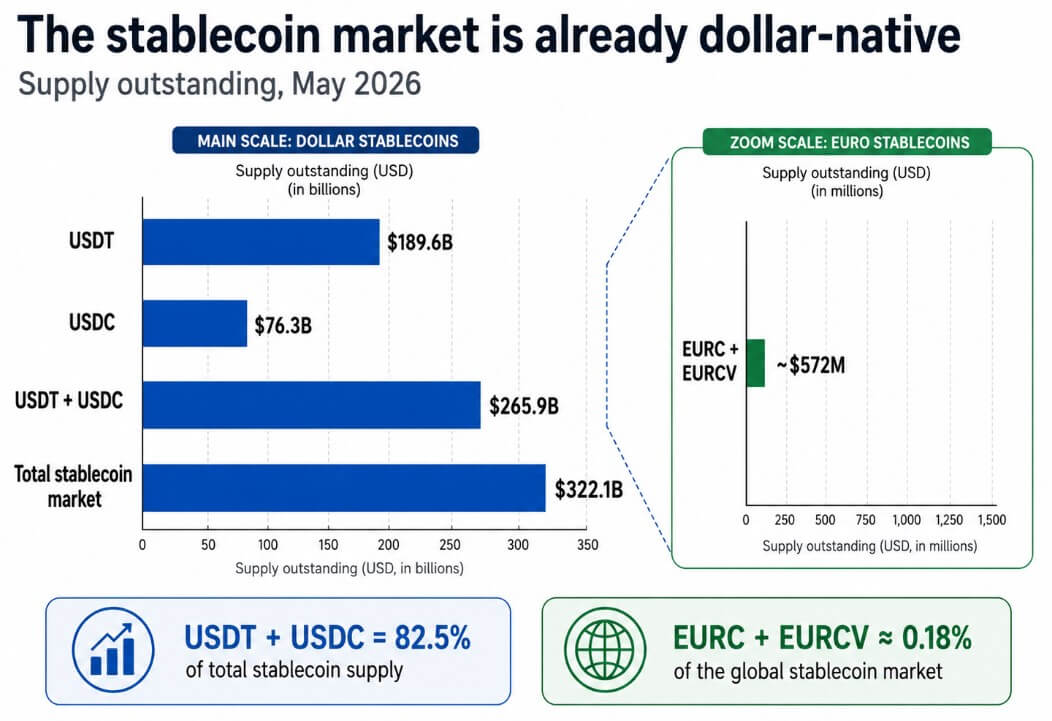
DeFiLlama puts the global stablecoin market at $322.1 billion, with USDT at $189.6 billion and USDC at $76.3 billion, accounting for 82.5% of the total supply.
Circle reports €387.9 million EURC in circulation as of May 18, while SG-FORGE’s EURCV stands at €105.6 million.
Those two leading euro tokens together equal roughly $572 million, about 0.18% of the global stablecoin market, and now Europe’s distribution play must close a roughly 450-to-1 window before it can contest the rails.
Why the dollar’s lead is structural
The Kansas City Fed estimated that as of November 2025, 48.8% of stablecoins were used as trading assets across exchanges, finance protocols, and infrastructure, while traditional payments accounted for only 0.7% of stablecoin use.
CEX.IO’s data for the first quarter shows stablecoins accounting for 75% of all crypto trading volume, with USDT alone accounting for 68% of all crypto volume and 86% of stablecoin trading volume.
Traders use the deepest pairs, applications integrate the most liquid tokens, and market makers carry dollar-stablecoin inventory because that is where volume flows.
The White House fact sheet on the GENIUS Act states that the law will strengthen the dollar’s status as a reserve currency and increase demand for US Treasuries by requiring stablecoin issuers to back their assets with dollars and Treasury bills.
ECB President Christine Lagarde responded in May 2026 by noting that every dollar stablecoin that scales also scales up demand for dollar-backed assets, and cited a research finding that a $3.5 billion inflow into dollar stablecoins can lower three-month Treasury bill yields by 2.5-3.5 basis points.
RWA.xyz shows $33.8 billion in distributed tokenized real-world asset value and $340 billion in represented asset value, with tokenized US Treasuries alone at over $15.4 billion. Every tokenized asset has a settlement leg, and most of those legs are currently settled in dollar stablecoins.
If European bonds, real estate funds, and trade receivables continue to settle in USDT or USDC, European corporates will have moved their assets on-chain, making them dollar-native by default.
Europe’s counterattack runs through bank networks
Under the EU’s Markets in Crypto-Assets regulation, euro-denominated stablecoins issued by regulated entities can operate across member states without separate national licenses.
That gives Qivalis a compliance advantage that Tether, which holds no MiCA license, cannot easily replicate. The bank-distribution layer is what separates Qivalis from EURC, which has yet to attract the institutional liquidity required for scale.
The architecture being formed comprises corporate treasury management, cross-border supplier payments, and settlement of blockchain-based bonds and fund shares. Those are institutional workflows where bank connectivity and counterparty support determine adoption.
Qivalis is betting that 37 banks can make euro stablecoins available to corporate treasurers, who receive stablecoins through their banking partners.
Liquidity traps and regulatory overcorrection
JPMorgan projects the stablecoin market will reach roughly $500 billion by the end of 2028, which, from the current $322.1 billion base, implies about 18.6% annualized growth.
In that scenario, dollar stablecoins grow proportionally, and the overall market fails to expand fast enough to give euro tokens room to build meaningful exchange depth.
Qivalis becomes a compliance product adequate for selected cross-border treasury pilots but unable to reset DeFi collateral preferences or exchange defaults.
The IMF’s COFER data for the last quarter of 2025 shows the euro at 20.25% of global official FX reserves, compared with the dollar at 56.77%.
In a bearish case, euro stablecoins replicate that disparity, and European tokenized assets continue to settle in digital dollars because USDT and USDC dominate exchange pairs, DeFi pool depth, and market maker inventories.
If the ECB or national supervisors constrain issuance of public-chain euro stablecoins in favor of tokenized deposits or a CBDC, Qivalis’s bank distribution network becomes irrelevant.
Banks that joined to offer a regulated stablecoin may end up offering a different instrument that does not interoperate with DeFi protocols or non-EU exchanges under a different framework.
That fragmentation leaves dollar tokens as the practical default for any transaction crossing the EU perimeter.
The euro settlement beachhead
Standard Chartered projects that the stablecoin market will reach $2 trillion by the end of 2028, with up to $1 trillion in net new demand for Treasury bills.
Reaching $2 trillion from $322.1 billion requires roughly 102.8% annualized growth, or about $54 billion of net supply growth per month through end-2028.
| Scenario | 2028 stablecoin market | Euro stablecoin share | Euro liquidity outcome | Strategic meaning |
|---|---|---|---|---|
| Bear / dollar trap | ~$500B | <1% | <$5B | Euro tokens remain compliance products; dollar rails dominate settlement. |
| Base / dual rail | ~$1T | 1–2% | $10B–$20B | Europe gets usable domestic rails, but global liquidity remains USD-led. |
| Bull / euro beachhead | ~$2T | 3–5% | $60B–$100B | Euro stablecoins become credible settlement assets for EU tokenized securities, funds, and corporate treasury flows. |
In that environment, euro stablecoins capturing 3-5% of the market would mean $60 billion to $100 billion in euro-denominated on-chain liquidity, sufficient to support genuine exchange depth, DeFi collateral use, and tokenized fund settlement at institutional scale.
Euro stablecoins can secure that position by becoming the default settlement asset for EU tokenized securities before those standards harden around dollar rails, a prize that carries its own logic independent of any displacement of USDT in global crypto trading.
The RWA market is still early, which means the window to establish euro-denominated settlement rails is open. If Qivalis reaches sufficient liquidity before tokenized EU assets adopt dollar defaults, European financial infrastructure avoids becoming dollar-native at the plumbing layer.
That outcome would decide whether the next generation of European corporate finance runs on digital euros or digital dollars.
The contest is over settlement defaults
Europe’s goal is to make euro-denominated money available at the moment when traditional finance moves on-chain and before defaults set in.
Qivalis’s 37-bank consortium is a bet that institutional distribution can generate the liquidity, counterparty network, and compliance stack integration that corporates require before they route treasury flows through a euro stablecoin.
Whether that bet pays off by the end of 2028 will depend on how fast tokenized asset markets expand, how aggressively European banks activate their Qivalis relationships, and whether regulators treat public-chain euro stablecoins as infrastructure worth protecting or as a risk worth constraining.
The post Europe’s 37-bank stablecoin push tests whether on-chain finance defaults to euros or dollars appeared first on CryptoSlate.