Bitcoin is trading near $86,000 as losses build across ETFs, treasury companies, and miners.

According to Checkonchain’s Dec. 15 “System Stress” note, investors are carrying about $100 billion in unrealized losses.
Miners are pulling back hashrate, many treasury-company stocks are trading below their Bitcoin book value, and about 60% of spot Bitcoin ETF inflows are underwater.
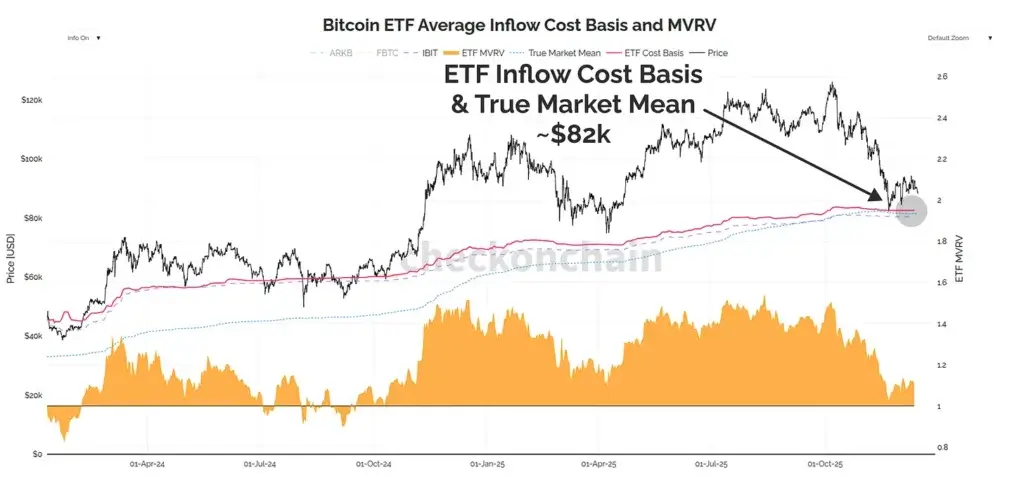
Checkonchain’s chart of ETF average inflow cost basis and ETF market value to realized value (MVRV) places the ETF cost basis and the True Market Mean in the same area, around $80,000–$82,000.
That puts a large share of institutional positioning near breakeven.
Those anchors matter because they connect price action to balance sheets rather than chart patterns.
When price sits on or below aggregate cost basis, realized losses can climb, and liquidity can thin as participants exit positions into bounces.
When that zone is shared by cohorts that had become key sources of demand in 2024 and 2025, the market is forced to determine whether institutional positioning serves as a cost-basis floor.
It can also flip into a downside trigger if that level breaks.
Glassnode sets a similar map
In its Week On-Chain report for week 49, Glassnode wrote that Bitcoin has been range-bound between the short-term holder cost basis near $102,700 and the True Market Mean near $81,300.
It framed $95,000 (the 0.75 cost-basis quantile) as an early reclaim level.
Bitwise also put the True Market Mean near $82,000 as a support reference.
It described a support channel from about $82,000 down to $75,000, tying that band to the IBIT cost basis near $81,000 and Strategy’s cost basis near $75,000.
Bitwise estimated unrealized losses at around $152 billion (about 6.6% of market cap) after a roughly 35% drawdown, bringing total losses to about $765 billion.
A stress feature is the amount of ETF capital between $75,000 and $85,000.
The aggregate spot Bitcoin ETF cost basis is around $80,000 under roughly $127 billion of capital.
However, only 2.9% of that capital sits in the $75,000–$85,000 band, leaving a thinner cushion if price slips below the central cluster.
Amberdata also described a denser “fortress” zone at $65,000–$70,000 that holds 15.2% of ETF capital.
That distribution can translate into faster downside moves if the market trades through the $75,000–$85,000 gap.
Loss realization is already elevated even when price rebounds
Glassnode put entity-adjusted realized loss (30-day simple moving average) near $555 million per day, the highest level since the FTX-era unwind.
It said this was occurring even as prices bounced from late-November lows into the low-$90,000s.
The same report placed the relative unrealized loss (30-day SMA) at around 4.4% after nearly two years, down from below 2%.
That aligns with Checkonchain’s view that the cycle has entered a stress regime.
ETFs remain central because they serve both as structural allocation rails and as a short-term liquidity valve.
According to Bitbo’s ETF tracker, U.S. spot Bitcoin ETFs collectively held about 1,311,862 BTC (about $117.3 billion) as of Dec. 15.
BlackRock’s IBIT held about 778,052 BTC (about $69.6 billion) after recording mixed flows over the last two weeks, culminating in a modest $100 million net inflow.
That is a reminder that ETF demand can flip quickly during risk-off periods.
Mining economics add another pressure point because weaker revenue can translate into inventory sales or deferred investment.
In its November lookback, Luxor’s Hashrate Index reported that the USD hashprice averaged about $39.82, down 17.9% month over month.
It hit an all-time low near $35.06 on Nov. 22.
Luxor said forward curves for December 2025 through April 2026 fell about 16–18% in USD terms.
Checkonchain also wrote that miners are pulling back hashrate.
That keeps attention on whether the sector is approaching a capitulation-style flush or a longer margin-compression phase.
The third cohort, Bitcoin-treasury equities, is facing a funding constraint at the same time.
Reuters reported that Bitcoin treasury companies bought about $50 billion of Bitcoin over the past year, but many are now trading at a discount to their net asset value.
That reduces the advantage of issuing equity to buy more Bitcoin.
When those shares are below the value of the underlying holdings, the “issue equity, buy BTC” flywheel becomes harder to run at scale.
Macro linkage has become the amplifier
Reuters cited LSEG data showing Bitcoin’s average correlation to the S&P 500 near 0.5 in 2025 versus about 0.29 in 2024.
It also cited a correlation with the Nasdaq 100 near 0.52, versus about 0.23, tying many drawdowns to equity risk regimes rather than crypto-only catalysts.
Rates matter in that setup because they set the tone for risk appetite. Bank of America expects two more cuts in June and July 2026.
That keeps the 2026 rate path near the center of the debate over risk assets.
Taken together, that causal stack is why Checkonchain calls the current setup the most negative since 2022.
Underwater capital is concentrated in cohorts with balance sheets that are sensitive to price; the reflexive buyer base has less funding flexibility; miner margins are compressed into early 2026; and Bitcoin’s link to risk assets is tighter than it was last year.
For readers trying to translate that into a forward-looking framework without turning it into trading advice, the stress can be tracked through measurable gauges.
| Level (approx.) | What it represents |
|---|---|
| $81k–$82k | True Market Mean and ETF inflow cost-basis cluster |
| $95k | 0.75 cost-basis quantile (reclaim marker) |
| $102.7k | Short-term holder cost basis |
| $75k | Lower bound in Bitwise support channel (MSTR cost basis reference) |
| $65k–$70k | Heavier ETF capital concentration |
On-chain, the first step is to determine whether realized-loss measures roll over from current levels as price stops printing new lows near the True Market Mean.
In flows, the question is whether large outflow days remain frequent or give way to steadier net behavior.
In mining, the watch point is whether hashprice and the forward curve stabilize into early 2026, or whether margin stress deepens and forces more operational retrenchment.
The next balance-sheet test remains the $80,000–$82,000 cost-basis band.
The post Bitcoin ETFs are 60% underwater, creating a $100 billion distressed house of cards appeared first on CryptoSlate.