Bitcoin ETFs grabbed $1.2 billion in the first two trading sessions of 2026, coinciding with BTC’s climb to $94,000, a 7% gain in just days. The narrative wrote itself: institutional money flooded in, prices followed.

Yet, that correlation masks a more complex structural shift unfolding across options markets, on-chain flows, and derivatives positioning, suggesting the rally’s foundation runs deeper than spot demand alone.
Paying up for convexity
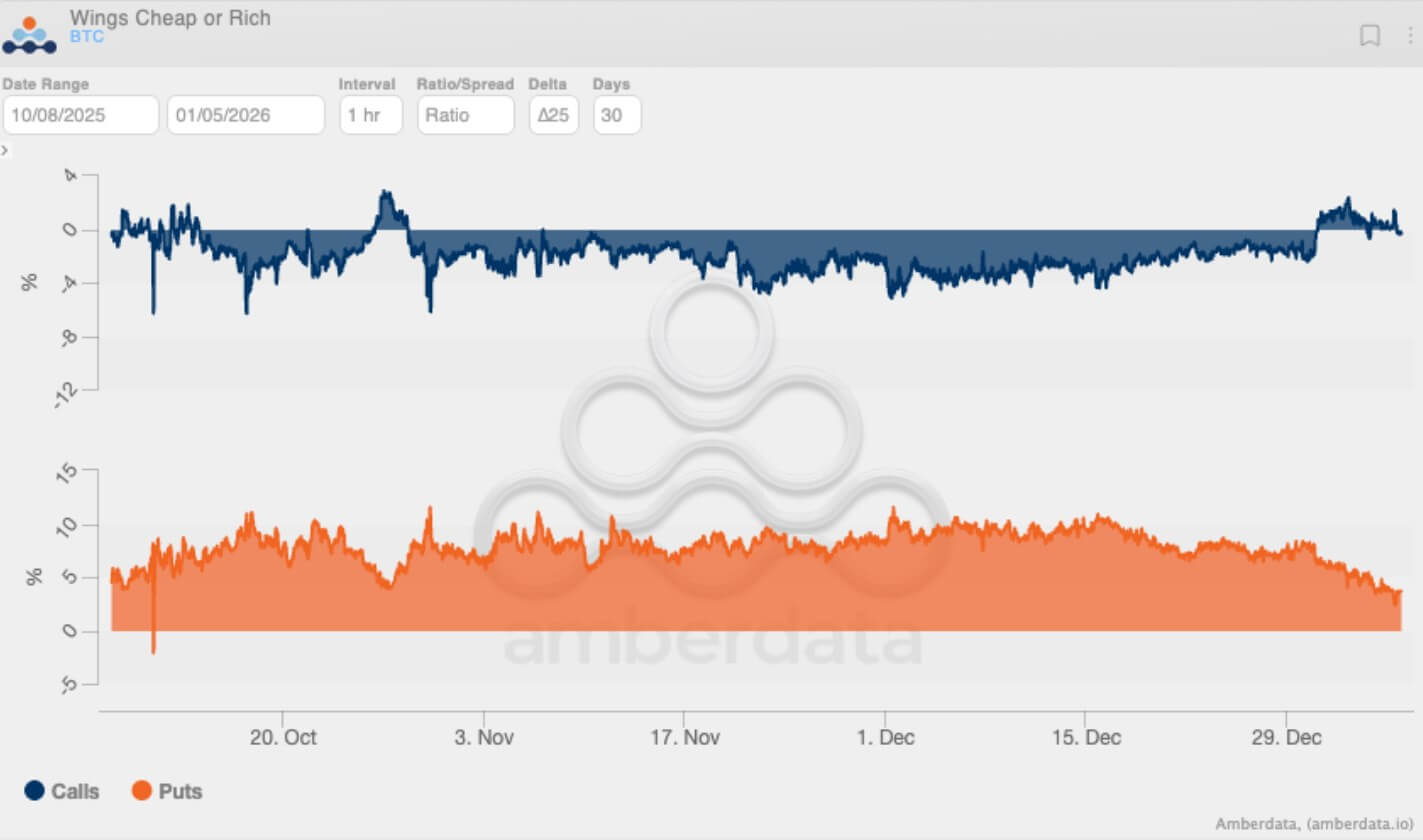
Jeffrey Park, CIO at ProCap BTC, flagged that Bitcoin options call skew flipped positive on Jan. 1 for the first time since October. He surfaced a signal institutional traders watch more closely than AUM tallies: the cost of upside protection relative to downside hedges.
Call skew measures the difference between the implied volatility of out-of-the-money calls and that of comparable puts, typically expressed as a 25-delta risk reversal.
When that spread turns positive, traders bid more aggressively for upside exposure than for downside insurance. The market charges a premium for convexity in one direction, which functions as a live vote on where participants expect the price to break.
Positive call skew reflects genuine demand for leverage on the upside, such as institutions positioning for breakouts, retail chasing momentum, or structured products needing call inventory.
The mechanical effect compounds this: when dealers sell those calls, they hedge by buying spot or futures as prices rise, creating a feedback loop that amplifies rallies.
The January flip in Bitcoin options skew didn’t just reflect sentiment; it reconfigured the derivatives landscape in a way that makes upside moves self-reinforcing through delta-hedging flows.
Supply redistribution and leverage dynamics
Checkonchain framed the rally through a different lens on Jan. 5, pointing to “massive supply redistribution happening under the hood.”
Top-heavy supply dropped from 67% to 47%, while profit-taking gradually collapsed from 30,721 BTC on Nov. 23 to just 3,596 BTC by Jan. 3.
The market wasn’t simply rising: it was rebalancing, with concentrated holders distributing to buyers willing to absorb supply without immediately flipping for profit.
When profit-taking evaporates while price climbs, it suggests new entrants are accumulating with longer time horizons.
The drop in realized profit removes sell-side pressure that typically caps rallies. Recent buyers entered at prices closer to current levels, creating a cohort less incentivized to exit on marginal gains.
The futures market added another layer. CoinGlass data showed $530 million in liquidations over 24 hours, with $361 million from shorts, a classic short squeeze that is helping the recent rally.
However, the squeeze occurred within a low-leverage environment. Checkonchain data shows that crypto-native leverage fell from 5.2% to 4.8% between Dec. 31 and Jan. 5, while global leverage dropped from 7.2% to 6.6%. Futures leverage inched up slightly to 3.3% but remained well below historical peaks.
When shorts get squeezed in a low-leverage regime, the unwind removes resistance without creating systemic fragility on the long side.
The lack of excessive leverage means the rally isn’t built on borrowed capital that would have to be deleveraged at the first sign of weakness. Spot-driven rallies don’t face the same reflexive deleveraging risk as futures-heavy moves.
The interplay between the mechanics of call skew repricing upside risk, supply consolidating into stronger hands, and leverage staying compressed creates a setup where catalysts like ETF inflows amplify rather than initiate the move.
The ETFs provided a narrative anchor and liquidity entry point, but the structural conditions that allow prices to hold gains were already in place.
Bitcoin’s breach of $94,000 marked the convergence of multiple structural indicators that suggest more conviction behind the move than spot flows alone would imply.
The post Bitcoin profit-taking has suddenly collapsed, exposing a massive supply shift that goes deeper than simple ETF demand appeared first on CryptoSlate.