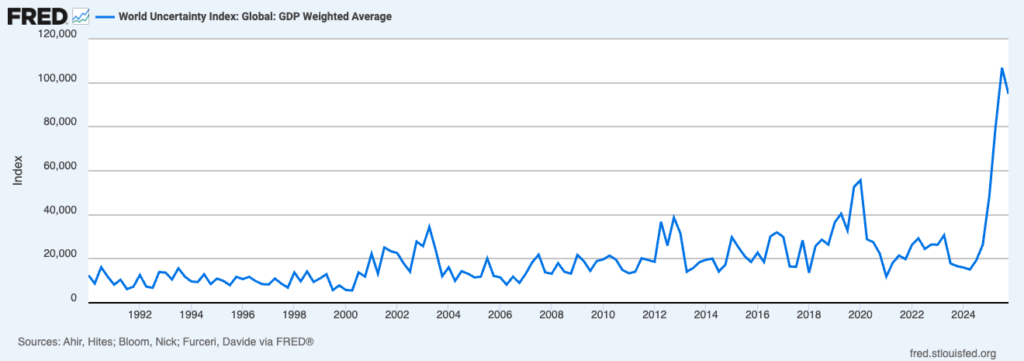
The World Uncertainty Index, a GDP-weighted measure constructed from the frequency with which “uncertainty” appears in Economist Intelligence Unit country reports, reached 106,862.2 in the third quarter of 2025 and remained elevated at 94,947.1 in the fourth quarter.

The index isn’t a volatility gauge. It’s a text-based barometer of policy, geopolitical, and economic ambiguity that can remain elevated even when equity markets price in calm.
The methodology rescales word frequency and aggregates it across countries, meaning the current reading translates roughly to 10 or 11 mentions of “uncertain” or “uncertainty” in a typical 10,000-word quarterly report per country, illustratively high by historical comparison.
What makes the current environment unusual is the divergence between that record headline uncertainty and the subdued pricing of stress in traditional risk markets.
The VIX sits at 17.66 as of Feb. 11. The MOVE index, which tracks bond market volatility, reads 62.74. The St. Louis Fed’s Financial Stress Index stands at -0.6558, below its long-term average and signaling below-normal stress as of the week ending Feb. 6.
Markets are pricing business as usual, while country analysts are writing about record ambiguity.
That disconnect matters for Bitcoin because the asset’s behavior splits depending on whether uncertainty remains confined to headlines or bleeds into actual financial conditions.
Currently, the macroeconomic variables that tend to dominate Bitcoin when it trades as a risk asset remain restrictive. The dollar index sat at 96.762 as of press time. The 10-year Treasury yield is 4.22%, and the 10-year TIPS real yield is 1.87% as of Feb. 9.
A weak dollar and elevated real yields often signal choppy price action and heightened sensitivity to policy expectations, flows, and volatility demand.
Bitcoin’s price has wobbled accordingly. BTC traded around $66,901.93 as of press time, down roughly 2.5% from the prior close.
Options markets have shown rising demand for downside protection, with Deribit’s implied volatility counter, DVOL, rising from roughly 55.2 to roughly 58 over the past 48 hours.
That move signals that traders are paying up for hedges, consistent with rising macroeconomic unease, even if spot volatility has not yet spiked.
Spot Bitcoin ETF flows tell a similar story of regime uncertainty rather than conviction.
Farside Investors’ data show that January recorded net outflows of over $1.6 billion, while February recorded net outflows of nearly $7 million as of Feb. 10, with the last three trading days reversing most of the capital flows.
The churn suggests institutional allocators are de-risking and re-risking in waves rather than holding a steady view, which is typical when macro clarity is low but immediate stress pricing remains muted.
The stablecoin market provides context for whether crypto’s liquidity base is intact.
Total stablecoin supply stands at roughly $307.5 billion, essentially flat over the past 30 days with a decline of just 0.25%. That figure is important because it represents on-chain purchasing power that hasn’t evaporated despite volatility in flows and sentiment.
The “dry powder” remains, awaiting a catalyst or a regime shift to deploy.
Two competing interpretations
Bitcoin’s next move depends on which of two plausible interpretations of the record uncertainty prevails.
The first interpretation treats high WUI as a precursor to tighter financial conditions. If policy and geopolitical ambiguity eventually translate into higher risk premia, weaker growth expectations, or flight to quality, Bitcoin tends to behave like a high-beta risk asset.
In that regime, a strong dollar and elevated real yields squeeze non-yielding speculative assets, and Bitcoin’s volatility rises with a downside skew.
Persistent ETF outflows would confirm that institutions are treating BTC as a liquidity sink to exit rather than a portfolio hedge.
The second interpretation treats high uncertainty as a signal of sovereign or policy credibility risk.
If ambiguity stems from capital controls, fiscal stress, sanctions spillover, or doubts about central bank independence, Bitcoin can benefit. Yet, historically, that bid is most evident when real yields fall, or liquidity conditions ease, rather than when the dollar is strengthening and nominal yields are rising.
The “non-sovereign hedge” narrative requires macro conditions that make holding cash or government bonds less attractive, which isn’t the case today.
What makes the current setup unusual is that WUI has reached record levels without financial conditions easing or stress indicators spiking. Markets are pricing neither panic nor relief.
The result is a holding pattern in which Bitcoin trades within a range, options markets signal caution, and institutional flows oscillate without a clear trend.
| Metric | Latest | What it implies |
|---|---|---|
| WUI | 106,862.2 (Q3 2025) / 94,947.1 (Q4 2025) | Record headline uncertainty |
| VIX | 17.66 | Equity vol still muted |
| MOVE | 62.74 | Rates vol subdued vs crisis regimes |
| STLFSI | -0.6558 | Below-normal systemic stress |
| DXY | 96.762 | USD not in squeeze mode |
| 10Y yield | 4.22% | Nominal hurdle rate high |
| 10Y real yield | 1.87% | High opportunity cost for non-yielding assets |
| BTC | $66,901.93 | Rangebound / wobbling |
| DVOL | 55.2 → 58 (48h) | Hedge demand rising |
| Spot BTC ETF flows | Jan -$1.6B; Feb ~ -$7M (to Feb 10) | Churn, not conviction |
| Stablecoins | $307.5B (-0.25% 30D) | Dry powder intact |
Variables that decide the outcome
Real yields and the dollar are the simplest variables to watch.
A rollover in the 10-year TIPS yield, or a weakening in the broad dollar index, would signal that macro conditions are shifting toward the second regime, where uncertainty becomes a tailwind rather than a headwind for Bitcoin.
Historically, Bitcoin’s strongest rallies have occurred when real yields fall, and liquidity expands, even if headline uncertainty remains high.
ETF flows are the second tell. If inflows stabilize and remain persistently positive after the late-January drawdown, this suggests that institutions are treating the current uncertainty as an opportunity to add exposure rather than as a signal to de-risk further.
Conversely, if outflows resume, it confirms that Bitcoin remains a risk-off sell for traditional allocators.
Options markets provide a third signal. If DVOL remains elevated and demand for downside hedges persists, it indicates that traders expect volatility to rise even if spot prices have not yet broken down.
That setup can precede either a sharp move lower or a volatility spike that clears the range, depending on which macro variables shift first.
The gap between record WUI and subdued VIX or MOVE is the clearest tell of all. If policy and geopolitical uncertainty are finally priced into traditional volatility measures, it would confirm that the current calm is breaking down and Bitcoin’s “risk asset” reflexes are likely to predominate.
If WUI remains high but stress indicators remain low, it suggests that uncertainty is priced into narratives and forecasts but not into positioning. This setup favors a sharp Bitcoin move in either direction, depending on the next macroeconomic catalyst.
What’s clear is that Bitcoin is trading within a regime in which the asset’s two competing identities, high-beta risk asset versus non-sovereign hedge, are both plausible but require opposite macroeconomic conditions to be activated.
Record uncertainty doesn’t resolve that tension. It amplifies it, and the asset’s next move depends on whether uncertainty becomes stress or stays confined to country reports and analyst forecasts.
The post Global economic uncertainty at its worst ever, doubling 2008 recession levels – can Bitcoin navigate it without a crash? appeared first on CryptoSlate.