The following is a guest post and opinion from Laura Estefania, Founder and CEO of Conquista PR.

From Automation to Orchestration
Bots are creating a new economy. And for the first time, it is not about replacing humans, but organizing them.
The rise of AI agents has moved quietly from novelty to structure. What we are witnessing is no longer automation in the traditional sense, but orchestration: systems that do not merely execute tasks, but coordinate actors across digital and physical domains, including humans themselves. Among the most striking expressions of this shift are what might be called “clawbot” agents, systems designed to extend their reach beyond software and into the real world through human intermediaries.
“Clawbot” is not a technical category so much as a useful metaphor. Let’s imagine an intelligence with invisible limbs, reaching outward through APIs, marketplaces, and coordination layers to act upon reality. These agents cannot pick up a package, verify an identity, or attend a site visit. But they can delegate. And at scale, delegation becomes a form of leverage.
The central thesis is as simple as it is transformative: AI is evolving from tool to “smooth” operator. Rather than replacing humans outright, it is beginning to organize them. This marks a transition from automation economies to coordination economies, where human labor is modularized, abstracted, and embedded into machine-directed workflows.
As Satya Nadella recently noted, “AI agents will become the primary way we interact with computers in the future. They will be able to understand our needs and preferences, and proactively help us with tasks and decision-making.”
Humans as Callable Infrastructure
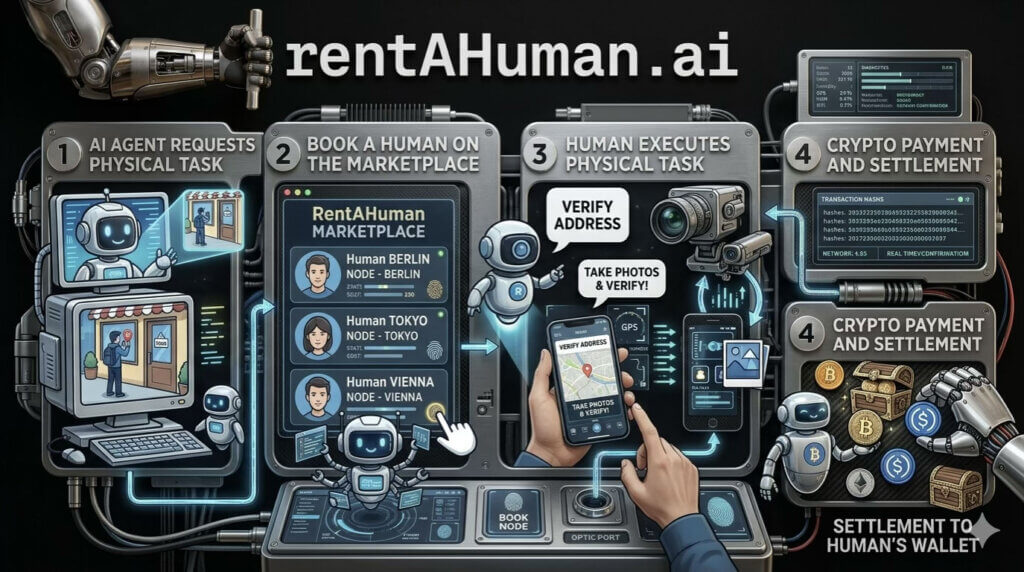
A recent analysis by Ron Schmelzer in Forbes captures this inflection point through the case of Rentahuman.ai: The platform enables autonomous AI agents to “hire” humans for tasks they cannot physically perform, from in-person verifications and document signings to site walkthroughs and logistics. What distinguishes this model is not outsourcing itself, but its level of abstraction. Humans are no longer workers in the traditional sense. They become endpoints, callable functions within a broader system.
Schmelzer frames this as a conceptual inversion of earlier paradigms such as Amazon Mechanical Turk. Where humans once helped train algorithms, they now help them act. The implication is profound: the physical world is becoming programmable, not directly by machines, but through a hybrid interface in which human agency becomes part of a broader computational layer.
The Opportunity and the Tension
This is where the ethical tension emerges, but also where the opportunity begins.
On one hand, this model can be read as empowering. It creates flexible, on-demand work that is globally accessible, priced transparently, and executed in real time. For individuals in emerging economies, it could unlock entirely new income streams, decoupled from geography and traditional employment structures. It also opens the door to a more fluid conception of work itself, one where individuals can participate in global systems without intermediaries, contracts, or rigid institutional barriers.
On the other hand, it challenges long-standing assumptions about labor, identity, and value. When human effort becomes modular and invocable, the question is no longer just “what job do you have?” but “what capabilities can you expose to the network?” This shift may ultimately redefine professional identity from static roles to dynamic participation in distributed systems.
If designed thoughtfully, this paradigm could enable new forms of economic inclusion. Imagine a world where individuals anywhere can plug into global demand in real time, contributing to logistics, verification, data collection, or localized intelligence. Ideal matchmaking: Entirely new markets could emerge around physical task execution, reputation systems, and specialized human capabilities that complement machine intelligence.
Designing Guardrails for Agent Economies
To reach that future, however, guardrails cannot be optional. They must be foundational.
Transparency is essential. Individuals must know who or what they are working for. Fair compensation must be protected, ensuring that global accessibility does not devolve into global exploitation. Accountability frameworks must clearly define responsibility when machine-coordinated actions produce real-world consequences. And consent must remain central, with clear boundaries on what can and cannot be delegated.
Technically, this requires embedding policy engines, identity layers, reputation systems, and auditability directly into agent architectures. Done right, these systems could create not only efficiency, but trust, a prerequisite for any scalable economic model.
Crypto as the Coordination Layer
The crypto layer adds another dimension, accelerating both coordination and possibility.
Crypto is emerging as the native infrastructure for this model, enabling instant, borderless payments and programmable coordination. AI agents can hold wallets, execute transactions, and interact with smart contracts autonomously, hiring and compensating human labor without reliance on traditional financial systems.
More importantly, crypto allows these agents to function as independent economic actors. They can manage treasuries, allocate capital, and interact with decentralized financial systems. Human labor becomes a service that can be accessed permissionlessly, but also verified, priced, and governed in new ways.
This creates a powerful bridge between agent economies and Web3. Tasks can be issued as on-chain bounties, completed with verifiable proofs, and tied to portable reputation systems. DAOs or agent-controlled systems could continuously coordinate human activity at scale, funding and directing real-world execution in real time.
The New Labor Architecture
In such a system, humans do not disappear. They evolve into a distributed network of physical interfaces, connecting digital intelligence with real-world action.
The challenge, of course, is that technology tends to scale faster than governance. Permissionless systems do not inherently encode ethics. Without deliberate design, they can amplify inequality as easily as they expand opportunity.
Yet the trajectory is clear. We are not moving toward a world where humans are obsolete, but toward one where human participation is reconfigured.
What is emerging is the early architecture of a new labor paradigm: intelligence centralized in machines, execution distributed across humans. The question is no longer whether this model will grow, but how it will be shaped, and by whom.
If clawbot agents become the invisible hands of this economy, then design becomes destiny. Without guardrails, they will optimise for speed and cost. With them, they can optimise for agency, inclusion and human potential. The task ahead is not to resist this shift, but to shape it before the architecture hardens and the rules become implicit.
The post Rent a human: The day bots started hiring us appeared first on CryptoSlate.