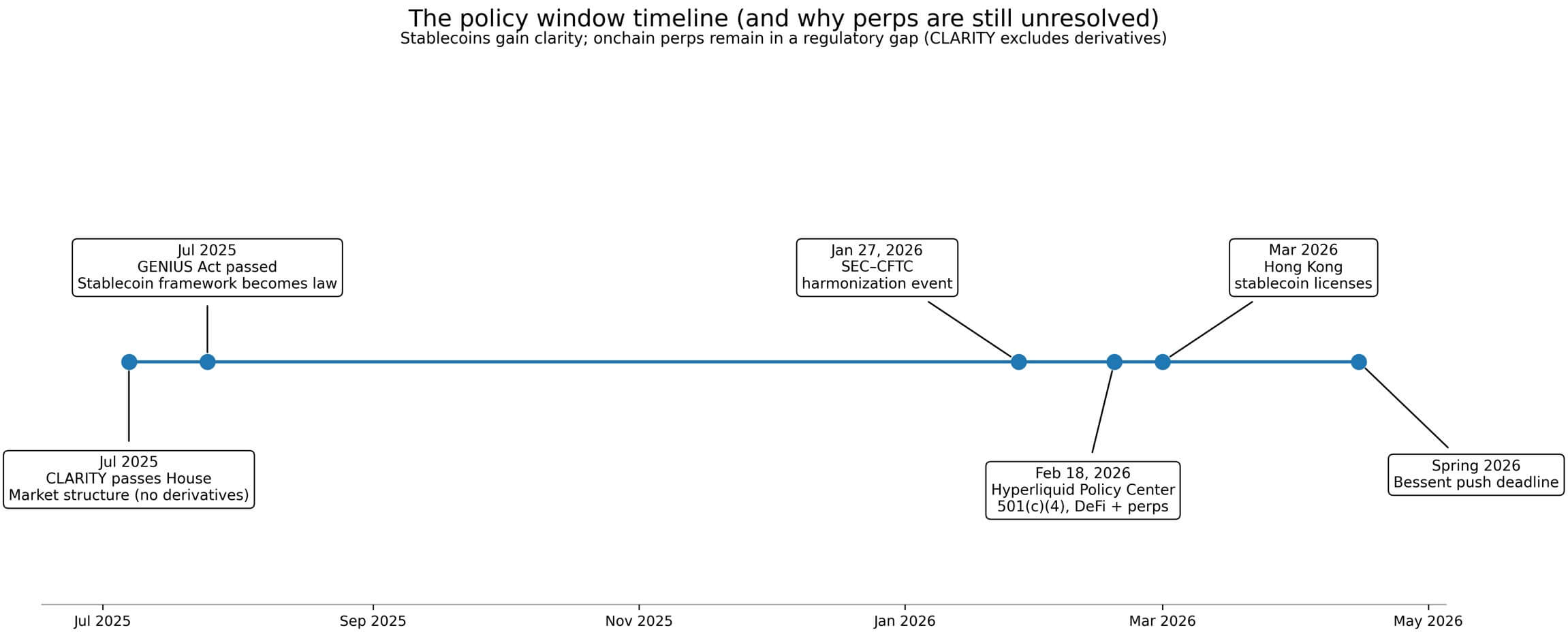
Hyperliquid launched a policy center in Washington on Feb. 18, seeded with 1 million HYPE tokens worth roughly $28 million, led by Jake Chervinsky, the crypto lawyer who spent years building the industry’s Capitol Hill playbook.

The Hyperliquid Policy Center operates as a 501(c)(4) focused on decentralized finance and perpetual derivatives. This isn’t just another crypto company hiring lobbyists. It’s a protocol that funds a sustained DC presence with its native token, making policy infrastructure part of the product itself.
The move signals something broader: DeFi’s “code routes around regulation” era is coming to an end. Policy is now part of the moat. And the battleground is derivatives, because perpetual futures are the largest real on-chain use case that US regulators still don’t know how to handle.
Why derivatives are the line
Hyperliquid processed $256 billion in perpetual futures volume over the past 30 days, with open interest exceeding $5 billion.
When a venue becomes meaningful market infrastructure for leveraged trading, it attracts scrutiny. The UK maintains its ban on retail crypto-derivatives even as it loosens other access.
The CFTC brought enforcement actions against bZeroX and Ooki DAO for offering illegal off-exchange digital-asset trading. Perps dominate crypto derivatives markets, accounting for roughly 75% of total activity, largely because onshore rules remain ambiguous.
Perpetuals don’t expire and use continuous funding rates instead of settlement mechanics. That simplicity creates regulatory friction: perps don’t fit cleanly into existing commodity futures statutes.
Chervinsky told Fortune that perps offer “more direct exposure to the underlying asset” than traditional derivatives, but that same design makes them harder to regulate.
The Hyperliquid Policy Center exists to make perps legible to lawmakers before lawmakers make them illegal by default.
The DC window for DeFi is open
Treasury Secretary Scott Bessent told Congress it needs to pass a major crypto market-structure bill by spring 2026, warning the coalition could fracture if delayed.
The SEC and CFTC held a joint harmonization event on Jan. 27. These aren’t abstract conversations, they’re drafting sessions for the map.
The CLARITY Act passed the House in July 2025 and sits in the Senate Banking Committee. It establishes a federal market structure for digital commodities, including frameworks for exchange and broker registration, and defines terms such as “mature blockchains.”
However, the Congressional Research Service’s analysis explicitly states that CLARITY’s framework excludes derivatives. Even if market structure legislation passes, leveraged perpetuals remain unresolved.
Meanwhile, stablecoin regulation is becoming law. The GENIUS Act was passed in July 2025, establishing a federal framework for a stablecoin. Standard Chartered forecasts that stablecoin supply will grow to $2 trillion by 2028.
The contrast is stark: payment rails are gaining clarity, while trading rails remain ambiguous. This split defines crypto’s next DC battle.
The K Street numbers
Digital asset sector lobbying spending rose 66% to $40.6 million in 2025, according to OpenSecrets data. Big banks spent $86.8 million.
Crypto is learning DC the TradFi way: sustained institutional presence, technical research, relationship cultivation. Hyperliquid’s $28 million seed round exceeds what most crypto advocacy groups spend in a year. The Digital Chamber spent $5.6 million in 2024, and the Blockchain Association spent $8.3 million.
The Hyperliquid Policy Center isn’t alone.
The DeFi Education Fund has operated since 2021. Ethereum ecosystem protocols formed the Ethereum Protocol Advocacy Alliance in November 2025. The Solana Policy Institute exists.
These aren’t ad hoc legal defense funds. They’re institutionalized policy layers operating as 501(c)(4) nonprofits with full-time staff and Hill briefing schedules.
What a policy moat means
DeFi venues now compete on three dimensions: market design (user experience, liquidity, fees), compliance design (what can be compelled, who controls interfaces), and narrative design (how “decentralized” gets defined in statute).
CLARITY creates registration concepts for digital commodity exchanges and brokers, but explicitly excludes derivatives, leaving perps in regulatory limbo.
The practical implication: even if Hyperliquid’s protocol remains globally accessible, US-facing front ends will face pressure to adopt registration-like standards, such as surveillance, disclosure, segregation, and KYC gating.
The question is whether the US uses routes through compliant intermediaries or targets control points, such as operators and governance participants, for enforcement.
The CFTC’s enforcement history suggests regulators will pursue the latter if the former doesn’t materialize.
Three paths forward
The next six to eighteen months will determine how the US treats rules on decentralized derivatives.
The first scenario consists of regulated access paths emerging. Spring 2026 legislation passes, with follow-on guidance on derivatives. US-facing front ends adopt registration-like standards while base protocols remain globally accessible.
Volume consolidates into venues that can afford compliance, creating policy moats.
The second scenario is if front-end chokepoint crackdowns intensify. Enforcement focuses on control points, such as operators and governance actors. Geofencing proliferates, US-facing interfaces degrade, and retail users get pushed offshore. Trading continues but fragments between jurisdictions.
The third scenario becomes concrete if legislative breakdown leaves perps offshore.
The coalition Bessent warned about fractures. CLARITY stalls or passes without derivatives provisions. The US gets clarity on spot and stablecoins, but leaves perps in a gray zone. Offshore dominance persists.
All three scenarios involve policy work. The difference is timing and leverage. Early engagement when rules are being drafted carries more weight than reactive defense when enforcement actions land.
| Scenario | Trigger / policy catalyst | Regulatory posture | What happens to US access | Market outcome |
|---|---|---|---|---|
| Regulated access paths emerge | Spring 2026 market-structure momentum holds; SEC/CFTC harmonization continues; follow-on work clarifies how onchain perps can fit into a compliant framework | “Yes, but” regime: permissioned rails + registration-like expectations for interfaces | US-facing front ends adopt KYC gating, disclosures, surveillance, segregation, and tighter controls; base protocols remain globally accessible but US UX becomes “regulated mode” | Volume consolidates into a few venues that can afford compliance; policy moats form; perps become more institutionally legible (but less permissionless) |
| Front-end chokepoint crackdown | Enforcement prioritizes control points (operators, key contributors, UI hosts, governance actors) after limited legislative progress | “Enforcement-first” posture: focus on intermediaries and “effective control” rather than protocol ideology | More geofencing, front-end shutdown risk, and degraded access; US users pushed to offshore routes/APIs and fragmented liquidity | Trading persists but routes around the US; liquidity fragments; compliance becomes a competitive weapon; higher legal risk premium for token-linked venues |
| Legislative breakdown → offshore dominance | Coalition fractures; CLARITY stalls or advances without derivatives; stablecoins get clarity while perps remain unaddressed | “No clear pathway” regime: derivatives remain in limbo; policy uncertainty persists | US access stays gray/limited; compliant onshore perps don’t materialize at scale; offshore remains the default | Offshore venues keep dominance; onchain perps grow globally but US participation is structurally constrained; DC becomes a recurring headline risk rather than a solved moat |
The shift nobody wanted to admit
For years, crypto has positioned decentralization as regulatory arbitrage: build systems that can’t be shut down and route around legacy rules.
That narrative is colliding with reality. When your protocol processes billions in daily volume, generates revenue flowing to token holders, and offers leverage to retail users in a 24/7 global market, you’re not routing around regulation.
Instead, you’re building parallel infrastructure that regulators will eventually force into their framework or shut out of their jurisdiction.
Hyperliquid’s move to Washington openly acknowledges this.
DeFi is entering its K Street era not because protocols have lost their ideological moorings, but because waiting for enforcement-driven precedent is riskier and less likely to produce workable rules.
While DC debates, Hong Kong plans to issue its first stablecoin licenses in March 2026.
The EU’s MiCA provides a live token framework. The UK loosens access to some crypto products while maintaining strict perimeter controls for derivatives. Chervinsky’s warning that “other nations seize the opportunity” isn’t hypothetical.
The next moat won’t just be technical superiority or liquidity depth. It will be compliance architecture that works, narrative frameworks that resonate with lawmakers, and relationships that let you shape rulemaking before rulemaking shapes you.
The market will test whether this works. If the Hyperliquid Policy Center helps secure a regulatory path for on-chain perps in the US, other protocols will follow suit.
If it doesn’t, the $28 million becomes a case study in expensive signaling. Either way, the experiment is live. DeFi went to Washington. Now, the market finds out whether Washington was waiting.
The post The CLARITY Act stalling keeps some crypto trading offshore — and US citizens get pushed out appeared first on CryptoSlate.