The Pentagon has sent the White House a request for $200 billion in additional funding for the Iran war, a figure that would equal nearly 3 million Bitcoin at current market prices.

At Bitcoin’s current price of about $68,600, the request converts to 2,915,451 BTC.
That framing does not mean the government is financing the war with crypto or treating Bitcoin as a payment rail for military spending. Instead, it offers a way to translate a large federal war bill into a unit investors can compare against some of the world’s most closely watched stores of value.
Seen that way, the request moves beyond standard Washington budget language and into a scale that is easier to grasp in market terms. It also arrives before any formal submission to Congress, where the proposal is already facing resistance from lawmakers in both parties.
What nearly 3 million Bitcoin looks like
The clearest way to understand the size of the request is to compare it with the largest Bitcoin holdings already in existence.
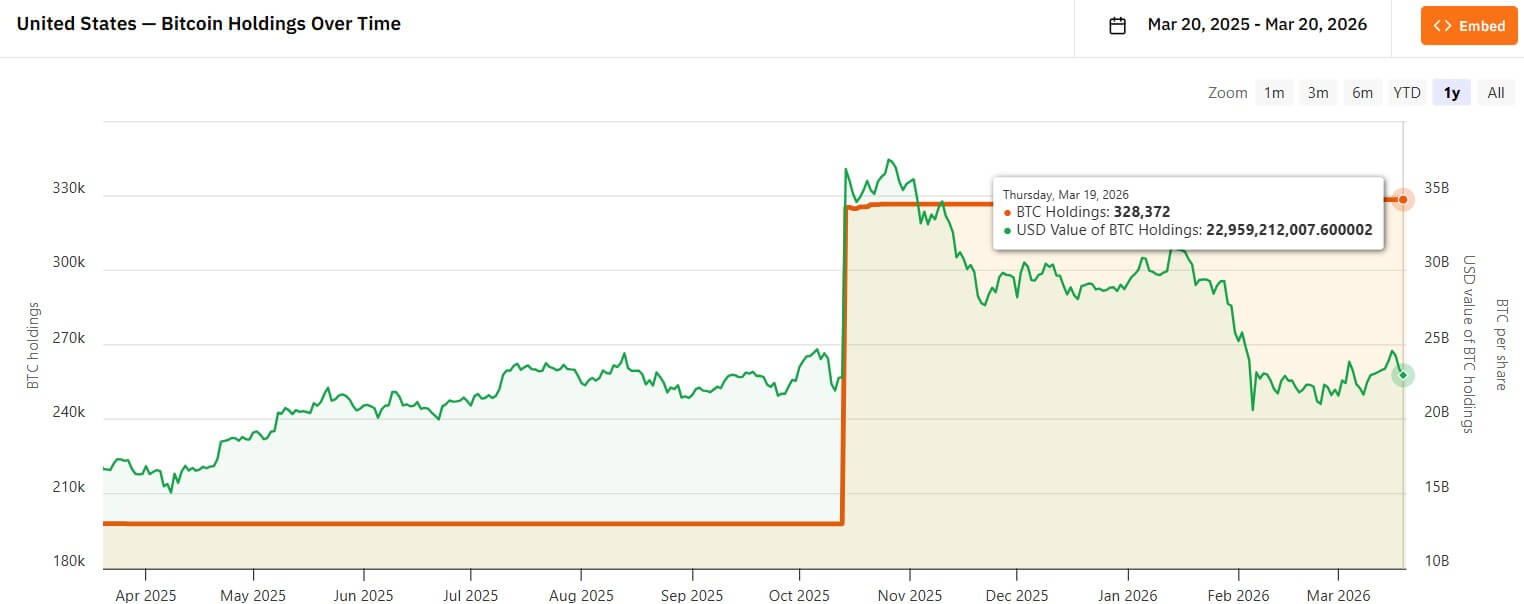
Start with the US government’s own position. Data from BitcoinTreasuries show that US government-related entities hold 328,372 BTC. At current prices, a $200 billion war request would equal roughly 2.82 million BTC, or about 8.6 times that amount.
The same imbalance appears when the comparison shifts to the market’s largest corporate and institutional holders.
Strategy, the biggest public corporate Bitcoin holder, is listed with 761,068 BTC. BlackRock’s iShares Bitcoin Trust (IBIT), the largest Bitcoin fund, held about 785,629 BTC based on its March 19 share count and basket data. Satoshi Nakamoto, the pseudonymous founder of the blockchain network, is widely estimated to hold about 1.096 million BTC.
On that basis, the war request would equal about 3.7 times Strategy’s stash, 3.6 times IBIT’s holdings, and 2.6 times Satoshi’s estimated cache.
Meanwhile, the scale remains striking even when measured against broader pools of institutional ownership.
The 10 US spot Bitcoin ETFs, including IBIT, hold about 1.52 million BTC combined, meaning the request would still equal about 1.86 times that total. BitcoinTreasuries also lists the top 100 public Bitcoin treasury companies with a combined 1,176,615 BTC, which means the request would be about 2.4 times larger than the entire group.
The comparison does not stop there. Even Binance, the world’s largest crypto exchange by trading volume, holds far less than the Bitcoin equivalent implied by the request.
In its March proof-of-reserves update, Binance said it held more than 639,000 BTC in wallets backing user balances. That puts the $200 billion figure at about 4.4 times Binance’s Bitcoin pile.
The number looks even larger when set against Bitcoin’s remaining issuance.
Blockchain.com shows 20,003,043 BTC already in circulation, leaving 996,957 BTC still to be mined before the network reaches its 21 million cap. At current prices, the war request would equal about 2.83 times all of the Bitcoin left to be mined.
Why the math looks easier in dollars than in Bitcoin
That gap points to the deeper distinction between a fiat system and a scarce digital asset.
War requests of this size can be made in dollars because the US government operates within a monetary system built around debt issuance and expanding supply.
Washington can authorize spending and finance it through Treasury borrowing, without first accumulating a fixed pool of scarce units. Treasury data show total federal debt has already climbed past $39 trillion, illustrating how spending on this scale is absorbed through deficits and bond issuance.
Bitcoin does not work that way. Its maximum supply is fixed in code at 21 million, and new coins enter circulation only through mining, a process that requires time, energy, hardware, and block-by-block issuance.
That makes Bitcoin far harder to gather at scale than fiat liabilities created through sovereign borrowing.
In practical terms, the US government can ask for another $200 billion because the dollar system allows it to keep extending its balance sheet through debt. It cannot do the equivalent in Bitcoin, because no authority can decree millions of new BTC into existence.
That difference is central to the argument many Bitcoin advocates have been making for years. In their view, Bitcoin is not only a store of value but also a monetary benchmark that exposes the scale of government spending in a way fiat often obscures.
Coinbase CEO Brian Armstrong captured it perfectly on X, saying:
”Bitcoin is a check and balance on inflation. When spending gets too far out of hand, capital moves to Bitcoin.”
That argument has already begun to shape policy language in Washington.
In March 2025, the Trump administration issued an order establishing a Strategic Bitcoin Reserve. The White House described Bitcoin as a reserve asset that should not be sold, while directing officials to study budget-neutral ways to acquire more.
For Bitcoin supporters, the broader point is straightforward: in a world where war costs, deficits, and debt continue to expand in fiat terms, a scarce asset with a fixed supply becomes more relevant as a reference point.
So, a $200 billion war request may be another line item in Washington. However, in Bitcoin terms, it looks like a claim on an amount of value that exceeds the holdings of governments, ETFs, exchanges, treasury firms, and even the supply still left to be mined.
The post White House faces Iran war bill that is worth nearly 3 million Bitcoin appeared first on CryptoSlate.